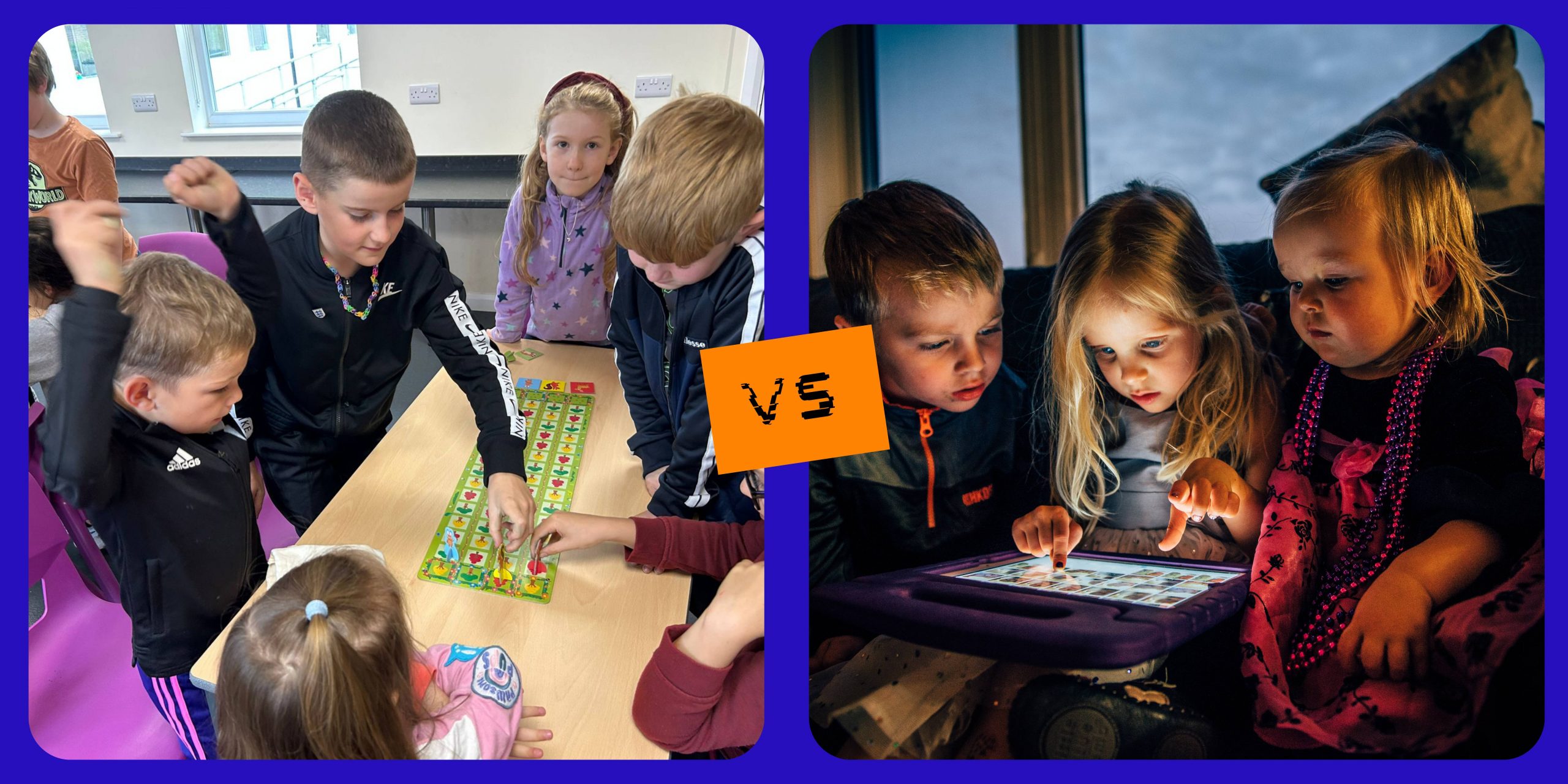
In today’s digital age, screens are everywhere. Shockingly, according to a 2025 study in the U.S., about 40% of children have a tablet by age 2, and over half of children aged 8 and under have their own mobile device. Similar trends are seen in the UK, with a recent Ofcom report found that about one in four UK children aged 5-7 own a smartphone, and roughly three-quarters use a tablet. Device ownership increases steeply with age: by ages 8-11, over 50% of children own a mobile phone.
These numbers show how early technology becomes part of children’s lives. While that brings certain advantages, it also makes it more important than ever to remember the power of hands-on, screen-free play, and of games you can touch, share, laugh over: tabletop, board, logic, and physical games.

What Screens Can’t Give – What Play Can
Hands-on, imaginative play (like board games, puzzles, role-play) provides many developmental benefits that screens struggle to replicate:
- Fine motor skills & tactile experience: Handling game pieces, shuffling cards, moving counters, all help children develop hand-eye coordination, precision, dexterity.
- Problem solving & logical thinking: Many tabletop games force players to plan, strategise, try different routes, adapt when setbacks happen.
- Social interaction & communication: Playing together means taking turns, listening to others, negotiating rules, sharing ideas, winning and losing gracefully. These are essential interpersonal skills.
- Creativity & imagination: Imaginative scenarios, “what if” thinking, inventing strategies or stories around the game, these stretch a child’s mind in ways more open-ended than many screen-based activities.
- Attention span & focus: Physical games often demand more sustained concentration, patience, reflection. Screens, with their fast changes, beeps, distractions, can encourage more rapid, shorter attention bursts.

Balancing Screens and Play
It isn’t about demonising screens. Digital tools, educational apps, online games can certainly have value. But balance is key. Some points to consider:
Monitor quality of screen content: Is it interactive, educational, cooperative? Or purely passive/fast-paced?
Ensure screen time doesn’t replace opportunities for hands-on, social, imaginative play.
Use tabletop games and other non-digital play as part of daily or weekly routines, games that invite conversation, cooperation, challenge.
Encourage children to reflect on their play (games), what they enjoyed, what was hard, what they learned, just as in your classroom reviews exercise. This strengthens metacognitive skills.
Why Tabletop Games Deserve a Place in School & Home
Cost-effective: A small collection of games can serve many children, for many sessions, with relatively little expense.
Low tech / easy to manage: No batteries, no updates, less risk of distractions or technical glitches.
Inclusive: Children who may struggle with screens (due to visual overload, motion, etc.) may find tabletop games more accessible.
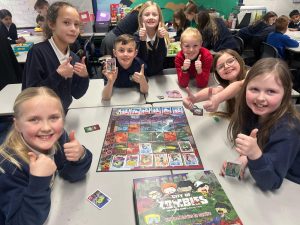
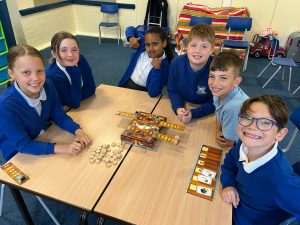
Emotional and psychological benefits: The opportunity to interact face-to-face, to co-create rules, to fail and try again, all build confidence, resilience, cooperation, empathy.
Conclusion
In a world increasingly mediated by screens, physical play and tabletop games are more than “just fun”, they are essential for holistic development. They support a range of skills from language, logic, attention, creativity, social and motor development, that screens alone can’t reliably provide.
As educators, parents, and caregivers, making space for play isn’t a luxury: it’s a necessity.